excellent response to the criticism of fair-trade coffee i posted earlier.

ed mayo's avatarEd Mayo's Blog

The halo effect of Fairtrade has lasted many years, despite periodic critics popping up wanting to complain either that it distorts markets or that it doesn’t distort them enough.

Development is a complex business and there is always a risk that Fairtrade is seen to overclaim what it can achieve as a way to tackle poverty. There is only so much you can pack into a label, or that you can unpack as a tool to address the deep inequalities of world trade. The research field on Fairtrade has grown over recent years, and played a helpful role in improving practice and standards from what its findings have been.

I remember sitting down with a colleague from Oxfam in 1991 in Brixton around the launch of the Fairtrade Mark and trying to write up standards for fair trade products. We were starting from scratch and it was extraordinarily amateur –…

View original post 380 more words

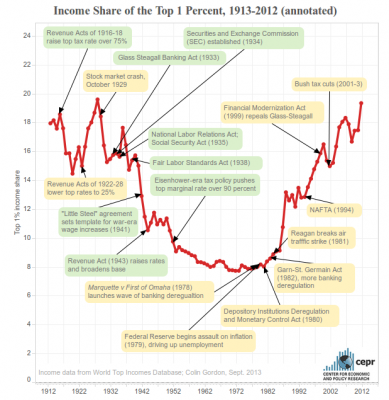
The Financial Times launched a strong critique of Thomas Piketty’s influential Capital in the Twenty-First Century but this is overall a nitpicking disingenuous apology for the 1% (no surprise):

  1. http://blogs.ft.com/money-supply/2014/05/23/data-problems-with-capital-in-the-21st-century/%5B/embed/lili%5Bembed%5Dhttp://www.huffingtonpost.com/2014/05/27/thomas-piketty-ft_n_5400214.html?1401233351
  2. http://www.livingwork.ca/?p=142

gordon-piketty-saez-389x400

From http://www.systemiccapital.com/fairtrade-coffee-fails-to-help-the-poor/

Research published by the School of Oriental and African Studies (SOAS) at London University reveals that workers at Fairtrade certified farms are paid less and suffer inferior working conditions compared with those working for non-Fairtrade farms.

The criticism emerges after a four-year research project conducted by development economists at SOAS. Funded by Britain’s Department for International Development, the researchers investigated labour markets for export crops in Ethiopia and Uganda. The micro-study of life for the rural poor involved 1,000 days of field research and the data covered 1,700 respondents including focus groups and life histories.

The latter expose the often appalling conditions suffered by workers picking the coffee beans and carnations that end up on supermarket shelves in Europe, the U.S. and Canada. The report titled Fairtrade, Employment and Poverty Reduction in Ethiopia and Uganda is at times a grim chronicle of exposure to harmful pesticides, workers forced to pay bribes to secure employment as well as violence and sexual abuse.

The report’s conclusion will come as a shock to consumers in rich countries who pick brands carrying the Fairtrade logo, supposedly supporting the earnings of family farms and small-holders by paying of a “Fairtrade premium,” helping them compete in a world dominated by large plantations.

MORE…

http://www.theglobeandmail.com/report-on-business/international-business/fairtrade-coffee-fails-to-help-the-poor-british-report-finds/article18852585/

Hear Darrick Hamilton, Associate Professor of Economics and Urban Policy at The New School (http://www.newschool.edu/) for Public Engagement (http://www.newschool.edu/nspe), speaking at the New School Minute, where faculty from every school present their timely and celebrated research in a series of rapid-fire 60-second lectures.

I went to grad-school at the University of North carolina at Chapel hill with Darrick!! :D

Video  —  Posted: 2014/05/28 by Punkonomics (@dearbalak) in Links/Articles/Video, YouTube
Tags: , , , , , , ,

Like in mathematics and philosophy, and as I teacher, I find it very useful to push argument to their logical extremes in order to try to make sense of them. So let’s consider the whole gender/race apologetics captured recently by #notallmen and the counterpart #yesallwomen

Specifically in this short post I want to consider the resistance to the idea of white-supremacy and patriarchy/male-supremacy. So many well-meaning (and others) white people and/or men, refuse to see the obvious fact of white-supremacy as it is clearly evidenced by history and data. They generally resort to complaints about how things are better and how the others (blacks, women, etc) are just as racist/sexist as whites/males. I try to explain this (after taking deep breaths) by saying that the context is different! When a white man talks about black men seducing white women, there is a context of mass rape of slaves and thousands of lynchings in the early 20th century for example. There is no similar history from the other side is there? When rich white males complain that THEY are looked down upon, there is a context of 500 years brutal colonization and enslavement–not the other way around.

So how would extremes help? Consider a Nazi guard at a concentration camp complaining that the jews hate him and don’t appreciate that he only took this job because the other option would be to go fight in the Eastern front and the SS. “I’m just doing what Aryan youth are expected to do; these jews are just as racist while I’m actually trying to treat them relatively well”

Helpful? CONTEXT!