Posts Tagged ‘capitalism’

from the Center for Popular Economics

http://www.populareconomics.org/2014/02/whose-recovery/

Whose Recovery?

Posted by  on February 18th, 2014

by Jerry Friedman

Whose Recovery

There is a story that when the late union leader Walter Reuther was given a tour of a GM plant, a manager introduced him to a set of the company’s new robots.  The manager challenged Reuther to say how he would organize the robots into the UAW.  The union leader supposedly responded by asking: how will General Motors sell cars to the robots?  While American unions have failed to organize the workers in the new economy’s factories, its capitalists seem to have figured out a good answer to Reuther’s question.

We shouldn’t be surprised that conservative politicians and orthodox economists are calling for the Federal Reserve to end its program of monetary ease and for the Federal government to end its program of extended unemployment insurance.  Believing in Say’s Law and the virtues of unregulated markets, they have never been comfortable with state action to help the unemployed; instead, they have long argued that the only proper role for government is to protect price stability and the integrity of banking system.

What should surprise us is that so few in the business community are pushing back against these ideologues in support of policies to bolster economic growth and employment.  Robert Reich asks whether capitalists and managers have forgotten the basic Fordist compromise, in which businesses rely on affluent workers to consume their products?[1]  If a rising tide lifts all boats, don’t capitalists benefit when unemployment falls and workers have more to spend?  And shouldn’t they support policies that bring the tide in?

They don’t because American capitalists have learned to profit from recession.  They have so well insulated their economic fortunes from the rest of us, that they no longer depend on rising wages and growing effective demand to maintain profitability.  The “recovery” from the Great Recession of 2008 has been different from past recoveries, because it has been led by profits, which have grown even though economic growth has been relatively slow, and employment and wages have stagnated.  Four years into the “recovery,” the GDP has grown at an anemic 2.4% per annum, the slowest growth rate of any post-war recovery and less than half that of the recovery in the 1960s.  Since the recession bottomed out in 2009, job creation has been only a third the rate of past recoveries.  Compared with past recoveries, this one is short 8 million jobs and the employment ratio, the share of the adult population with jobs, has fallen back to the level of the early 1970s, down 5 percentage points from 2008.

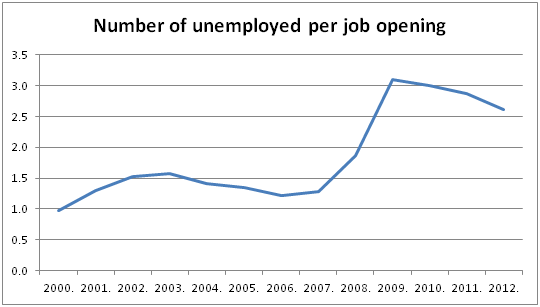
Those who call for the Federal Reserve to reverse course and urge Congress to cut programs to help the jobless cite the declining unemployment rate, which is down a third from its peak in 2009.  While declining unemployment is a good thing, much of the decline in the unemployment rate is because 10 million people have left the labor force.  The number of discouraged workers remains above its late 2009 level, while the number of unemployed workers per job opening has fallen only slightly from its 2009 peak (see Figure 1).  With the weight of unemployed and underemployed workers on the job market, wages have remained stagnant in this recovery despite rising productivity, continuing a decades-long trend.

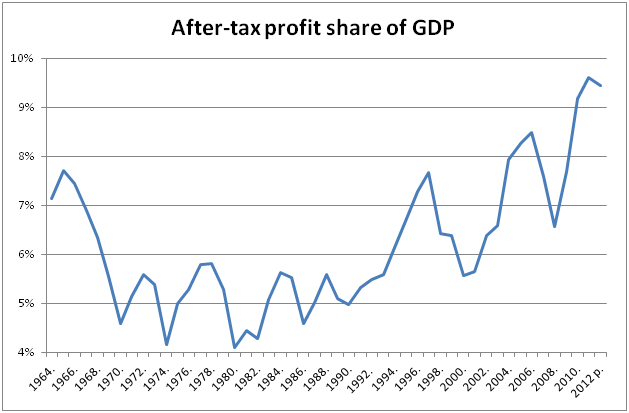
Despite slow economic growth, little job creation, and stagnant wages, some parts of the economy have boomed: the stock market and corporate profits.  After dramatic drops early in the recession, the Dow Jones Industrial Average has risen to new highs, growing in real terms significantly faster than in past recoveries.  While there may be some speculative element to the run-up in the Dow, it is well-supported by corporate profits, which have recovered fully from a sharp fall when the recession began to renew a 30 year climb (see Figure 2).
At least for now, American capitalists have solved the problem that bedeviled their Fordist forebears.  They have found ways to profit even when their workers cannot buy their stuff.  Since 2009, inflation-adjusted spending by the top 5% has risen 17 percent, compared with an anemic 1 percent among the rest.[2]  While Sears and J.C. Penney drift towards bankruptcy, Nordstrom and other luxury brands flourish.  Rather than depending on sales to working-class and middle-class consumers American corporations are doing very well selling to rich consumers, here and abroad.  Rather than promising workers high wages to ensure productivity, they maintain labor discipline through fear.

It seems that capitalists and managers have found answer to Reuther’s question. Business can’t sell stuff to robots, but they don’t need to sell stuff to workers either.


[1] “Why The Three Biggest Economic Lessons Were Forgotten,” accessed February 13, 2014, http://robertreich.org/post/76339971895.

[2] Nelson D. Schwartz, “The Middle Class Is Steadily Eroding. Just Ask the Business World.,” The New York Times, February 2, 2014, http://www.nytimes.com/2014/02/03/business/the-middle-class-is-steadily-eroding-just-ask-the-business-world.html; Barry Z. Cynamon and Steven M. Fazzari, Inequality, the Great Recession, and Slow Recovery, SSRN Scholarly Paper (Rochester, NY: Social Science Research Network, January 23, 2014), http://papers.ssrn.com/abstract=2205524.

http://www.nakedcapitalism.com/2014/02/versailles-watch-john-mack-whines-badly-wall-street-ceos-treated.html
#guillotine

when plunder be…

Posted: 2014/02/12 by Punkonomics (@dearbalak) in Links/Articles/Video
Tags: , , , ,

when plunder becomes a way of life for a group of men living together in society, they create for themselves in the course of time a legal system that authorizes it and a moral code that glorifies it (Frederic Bastiat)

http://www.huffingtonpost.com/2014/02/06/higher-ed-administrators-growth_n_4738584.html

New Analysis Shows Problematic Boom In Higher Ed Administrators

New England Center for Investigative Reporting  | by  Jon Marcus
Posted: 02/06/2014 11:56 am EST Updated: 02/06/2014 5:59 pm EST

Print Article

Main Entry Image 

The number of non-academic administrative and professional employees at U.S. colleges and universities has more than doubled in the last 25 years, vastly outpacing the growth in the number of students or faculty, according to an analysis of federal figures.

The disproportionate increase in the number of university staffers who neither teach nor conduct research has continued unabated in more recent years, and slowed only slightly since the start of the economic downturn, during which time colleges and universities have contended that a dearth of resources forced them to sharply raise tuition.

In all, from 1987 until 2011-12—the most recent academic year for which comparable figures are available—universities and colleges collectively added 517,636 administrators and professional employees, or an average of 87 every working day, according to the analysis of federal figures, by the New England Center for Investigative Reporting in collaboration with the nonprofit, nonpartisan social-science research group the American Institutes for Research.

“There’s just a mind-boggling amount of money per student that’s being spent on administration,” said Andrew Gillen, a senior researcher at the institutes. “It raises a question of priorities.”

Universities have added these administrators and professional employees even as they’ve substantially shifted classroom teaching duties from full-time faculty to less-expensive part-time adjunct faculty and teaching assistants, the figures show.

“They’ve increased their hiring of part-time faculty to try and cut costs,” said Donna Desrochers, a principal researcher at the Delta Cost Project, which studies higher-education spending. “Yet other factors that are going on, including the hiring of these other types of non-academic employees, have undercut those savings.”

Part-time faculty and teaching assistants now account for half of instructional staffs at colleges and universities, up from one-third in 1987, the figures show.

During the same period, the number of administrators and professional staff has more than doubled. That’s a rate of increase more than twice as fast as the growth in the number of students.

It’s not possible to tell exactly how much the rise in administrators and professional employees has contributed to the increase in the cost of tuition and fees, which has also almost doubled in inflation-adjusted dollars since 1987 at four-year private, nonprofit universities and colleges, according to the College Board. Those costs have also nearly tripled at public four-year universities—a higher price rise than for any other sector of the economy in that period, including healthcare.

But critics say the unrelenting addition of administrators and professional staffs can’t help but to have driven this steep increase.

At the very least, they say, the continued hiring of nonacademic employees belies university presidents’ insistence that they are doing everything they can to improve efficiency and hold down costs.

“It’s a lie. It’s a lie. It’s a lie,” said Richard Vedder, an economist and director of theCenter for College Affordability and Productivity.

“I wouldn’t buy a used car from a university president,” said Vedder. “They’ll say, ‘We’re making moves to cut costs,’ and mention something about energy-efficient lightbulbs, and ignore the new assistant to the assistant to the associate vice provost they just hired.”

The figures are particularly dramatic at private, nonprofit universities, whose numbers of administrators alone have doubled, while their numbers of professional employees have more than doubled.

Rather than improving productivity as measured by the ratio of employees to students, private universities have seen their productivity decline, adding 12 employees per 1,000 full-time students since 1987, the federal figures show.

“While the rest of the economy was shrinking overhead, higher education was investing heavily in more overhead,” said Robert Martin, an economist at Centre College in Kentucky who studies university finance who said staffing per students is a valid way to judge efficiency improvements or declines.

The ratio of nonacademic employees to faculty has also doubled. There are now two nonacademic employees at public and two and a half at private universities and colleges for every one full-time, tenure-track member of the faculty.

“In no other industry would overhead costs be allowed to grow at this rate—executives would lose their jobs,” analysts at the financial management firm Bain & Company wrote in a 2012 white paper for its clients and others about administrative spending in higher education.

Universities and university associations blame the increased hiring on such things as government regulations and demands from students and their families—including students who arrive unprepared for college-level work—for such services as remedial education, advising, and mental-health counseling.

“All of those things pile up, and contribute to this increase,” said Dan King, president of the American Association of University Administrators.

“I think there’s legitimate criticism” of the growth in hiring of administrators and other nonacademic employees, said King. “At the same time, you can’t lay all of the responsibility for that on the universities.”

There are “thousands” of regulations governing the distribution of financial aid alone, he said. “And probably every college or university that’s accredited, they’ve got at least one person with a major portion of their time dedicated to that, and in some cases whole office staffs. These aren’t bad things to do, but somebody’s got to do them.”

Since 1987, universities have also started or expanded departments devoted to marketing, diversity, disability, sustainability, security, environmental health, recruiting, technology, and fundraising, and added new majors and graduate and athletics programs, satellite campuses, and conference centers.

Some of these, they say—such as beefed-up fundraising and marketing offices—pay for themselves, and sustainability efforts save money through energy efficiency.

Others “often show up in student referenda, to build or add services,” said George Pernsteiner, president of the State Higher Education Executive Officers Association. “The students vote for them. Students and their families have asked for more, and are paying more to get it.”

Pressure to help students graduate more quickly—or at all—has also driven the increase in professional employees “to try to more effectively serve the students who are coming in today,” Pernsteiner said.

But naysayers point out that the doubling of administrative and professional staffs doesn’t seem to have improved universities’ performance. Since 2002, the proportion of four-year bachelor’s degree-seeking students who graduate within even six years, for instance, has barely inched up, from 55 percent to 58 percent, U.S. Department of Education figures show.

“If we have these huge spikes in student services spending or in other professional categories, we should see improvements in what they do, and I personally haven’t seen that,” Gillen said.

Martin said it’s true that adding services beyond teaching and research is fueling the growth of campus payrolls. But he said universities don’t have to provide those services themselves. “They can outsource them, the way that corporations do.”

To provide such things as security and counseling, said Martin, “You can hire outside firms, on a contract basis with competitive bidding. All these activities are a distraction from what the institution is supposed to be doing.”

Universities and colleges continued adding employees even after the beginning of the economic downturn, though at a slightly slower rate, the federal figures show.

“Institutions have said that they were hurting, so I would have thought that staffing overall would go down,” Desrochers said. “But it didn’t.”

There’s also been a massive hiring boom in central offices of public university systems and universities with more than one campus, according to the figures. The number of employees in central system offices has increased six-fold since 1987, and the number of administrators in them by a factor of more than 34.

One example, the central office of the California State University System, now has abudget bigger than those of three of the system’s 23 campuses.

“None of them have reduced campus administrative burdens at all,” said King, who said he is particularly frustrated by this trend. “They’ve added a layer of bureaucracy, and in 95 percent of the cases it’s an unnecessary bureaucracy and a counterproductive one.”

Centralization has been promoted as a way to reduce costs, but Vedder points out that it has not appeared to reduce the rate of hiring of administrators and professional staffs on campus—or of incessant spikes in tuition.

“It’s almost Orwellian,” said Vedder. “They’ll say, ‘We’ll save money if we centralize.’ Then they hire a provost or associate provost or an assistant business manager in charge of shared services, and then that person hires an assistant, and you end up with more people than you started with.”

In higher education, “Everyone now is a chief,” he said. “And there are a lot fewer Indians.”

This story was prepared by the New England Center for Investigative Reporting, a nonprofit news center based at Boston University and WGBH Radio/TV.

Paul Solomon’s report on PBS.org

Video Link

How one professor’s American dream — teaching — turned into the American nightmare (ARIK GREENBERG)

Adjunct professors now make up half of all college faculties, and 76 percent of instructional positions are filled on a contingent basis, according to the American Association of University Professors’ annual report on the “economic status of the profession.” There’s no starker way to consider adjuncts’ economic status than to hear that they’re paid an average of $2,000-$3,000 per class, with few to no benefits. At SUNY New Paltz, for example, between 1979 and 2008, adjunct pay has fallen 49 percent, while salaries for college presidents have increased 35 percent. The plight of adjuncts — what we’re calling “adjunctivitis” — is the subject on our upcoming Making Sense report.

One of the adjuncts in the broadcast segment is Arik Greenberg, who teaches theology at Loyola Marymount University. He’s been active in the movement to unionize adjuncts, and, at the invitation of the Service Employees International Union and the New Faculty Majority Foundation, recently took his case to the Rayburn building in Washington, DC, where he briefed congressional staffers on the working conditions of these part-time faculty. We wanted to share some adjuncts’ more personal struggles with our readers, and Greenberg was willing to adapt his testimony for the Making Sense page.

Arik Greenberg: I am an adjunct professor of theology at Loyola Marymount University, a major, private U.S. university. I have worked there for over 11 years, teaching consistently almost every semester. Despite the fact that I have the same credentials as my tenured colleagues, there is no opportunity for advancement. There are no full-time tenure-line positions that have opened or been established in my particular discipline at LMU for many years. However, they always seem to have more than enough classes that need to be taught in those very same disciplines, so they hire numerous part-timers to teach them.

As adjunct faculty members, we receive no benefits of any sort. I have never received a merit-based raise or a “promotion” (whatever that is), only the occasional cost-of-living adjustments that everyone else at LMU receives every few years. I have no job security, no assurance of academic freedom, no dedicated office space other than a small designated room that I share with four to five other adjuncts. I am also institutionally ineligible for the grants and professional development monies that tenure-line faculty have access to.

Working numerous jobs, some in the classroom and some in other segments of higher education, such as consulting and low level administrative work for small startup colleges, I have no time to contribute to research and publication in my chosen field. While I have done my best to publish, that part of my dossier is underdeveloped compared to others who hold tenure-line jobs. Their positions allow them to devote time to this; they are paid to do so. But when I should be researching and writing, I have to drive to another job. It has been this way with me for years. So even if a tenure-line job were to arise that I am eligible for, that gap in my dossier would hold me back, even though I have over a decade of highly successful teaching experience.

And even though I give my all to my teaching, my ability to grade and prepare for classes in a timely manner is hindered by the fact that I have to rush to another job. I could be offering more office hours or spending more time developing more effective courses and teaching methods.

Almost immediately after I first began teaching at my school, they hired me for a short-term “visiting” position, which was full-time, non-tenure track. But after two years of this full-time position, they deliberately let my contract lapse so that they would not be in danger of my suing them for tenure — a risk that universities face when employing a short-term contract employee for several consecutive years in a full-time position. This is common practice at our school and elsewhere.

But there was no evidence of my incompetence or lack of excellence in teaching. I had rave reviews from all my students and had wonderful relationships with all my colleagues, several of whom supported my candidacy for a full-time, tenure-track position. In fact, as evidence of my demonstrated prowess, after a short while they brought me back as a part-timer, and I have been employed there every semester since as an adjunct lecturer. I’m good enough to teach their students every semester for many years, but I’m not good enough to hire permanently?

After taking out nearly $140,000 in student loans to pay for grad school, and after years of financial hardship deferments, accrued interest has brought these loans to over $190,000. And on an adjunct lecturer’s salary, even augmented with other side jobs, I can neither support my family nor pay my student loans. My wife and I cannot afford to raise a child on our combined income, so we have waited to raise a family. Now at the age of 43, it may be too late.

And when my parents became ill, I couldn’t afford to move them in with me, arrange proper medical care or take enough family leave to be at my father’s side when he died. With the massive debts that my parents have left me, I risk losing the family home that I grew up in — that my grandfather built for us with his own hands — all because I am living on part-time wages.

Now that my parents are gone, I want to honor them by helping to change academia for the better. University administrations have failed to safeguard their hallowed halls against greed and the service of short-term savings, going the way of big business. And the accrediting bodies have failed to guide and censure them as well. If this situation continues unchecked, it will signal the destruction and disintegration of higher education as we know it, though many tenured faculty still do not recognize the inevitable, morbid outcome if this current trend is not immediately reversed.

I have no intention of letting that happen. My father was a grade school teacher. And he used to say that if not for the unions, teachers would have starved. Now, as an adjunct, I am experiencing what it would have been like for grade school teachers to be unsupported by the unions.

There is a growing movement of adjuncts who are willing to stand together to stem the tide of the avalanche. So when the union came to our campus in the fall of 2013, I took out my lucky pen and asked, “Where do I sign?” Our grassroots movement will prove to be the best thing that happened to higher education since the advent of the erstwhile tenure model, despite the common public opinion about unions fostering greed and mediocrity.

I’m fully educated; I stayed in school. Two masters and a Ph.D. I’ve published a book. I’ve paid my dues. I’ve followed the rules to realize the American dream, but I am now living the American nightmare. And I am not alone in this. I’m ready to work. All I want to do is contribute to the scholarship in my field and to teach my students effectively and passionately. But I need to earn a decent wage in order to do so.