Posts Tagged ‘justice’

We will have several local grassroots activists in the studio including our regular Miguel Adams from Speak Up Florida-The Movement to End the New Jim Crow (more details will be posted with the podcast).

We’ll try to be pragmatic and realistic but we will NOT allow ourselves to fall into the disgusting white supremacist racist rhetoric of the majority of the mainstream press and politicians (including President Obama).

It’s going to get ugly >:/

11209710_479457262202857_4187296884914580111_n

Why the real story of the Irish Famine is not taught in U.S. schools

So many textbooks overlook Ireland’s Great Hunger and the Irish American story.
MI+Tim+Pat+Coogan+the+Famine+Plot

“Wear green on St. Patrick’s Day or get pinched.” That pretty much sums up the Irish-American“curriculum” that I learned when I was in school. Yes, I recall a nod to the so-called Potato Famine, but it was mentioned only in passing.

Sadly, today’s high school textbooks continue to largely ignore the famine, despite the fact that it was responsible for unimaginable suffering and the deaths of more than a million Irish peasants, and that it triggered the greatest wave of Irish immigration in U.S. history. Nor do textbooks make any attempt to help students link famines past and present.

Yet there is no shortage of material that can bring these dramatic events to life in the classroom. In my own high school social studies classes, I begin with Sinead O’Connor’s haunting rendition of “Skibbereen,” which includes the verse:

… Oh it’s well I do remember, that bleak

December day,

The landlord and the sheriff came, to drive

Us all away

They set my roof on fire, with their cursed

English spleen

And that’s another reason why I left old

Skibbereen.

By contrast, Holt McDougal’s U.S. history textbook The Americans, devotes a flat two sentences to “The Great Potato Famine.” Prentice Hall’s America: Pathways to the Present fails to offer a single quote from the time. The text calls the famine a “horrible disaster,” as if it were a natural calamity like an earthquake.

And in an awful single paragraph, Houghton Mifflin’s The Enduring Vision: A History of the American People blames the “ravages of famine” simply on “a blight,” and the only contemporaneous quote comes, inappropriately, from a landlord, who describes the surviving tenants as “famished and ghastly skeletons.” Uniformly, social studies textbooks fail to allow the Irish to speak for themselves, to narrate their own horror.

These timid slivers of knowledge not only deprive students of rich lessons in Irish-American history, they exemplify much of what is wrong with today’s curricular reliance on corporate-produced textbooks.

First, does anyone really think that students will remember anything from the books’ dull and lifeless paragraphs? Today’s textbooks contain no stories of actual people. We meet no one, learn nothing of anyone’s life, encounter no injustice, no resistance. This is a curriculum bound for boredom. As someone who spent almost 30 years teaching high school social studies, I can testify that students will be unlikely to seek to learn more about events so emptied of drama, emotion, and humanity.

Nor do these texts raise any critical questions for students to consider. For example, it’s important for students to learn that the crop failure in Ireland affected only the potato—during the worst famine years, other food production was robust. Michael Pollan notes in The Botany of Desire, “Ireland’s was surely the biggest experiment in monoculture ever attempted and surely the most convincing proof of its folly.” But if only this one variety of potato, the Lumper, failed, and other crops thrived, why did people starve?

Thomas Gallagher points out in Paddy’s Lament, that during the first winter of famine, 1846-47, as perhaps 400,000 Irish peasants starved, landlords exported 17 million pounds sterling worth of grain, cattle, pigs, flour, eggs, and poultry—food that could have prevented those deaths. Throughout the famine, as Gallagher notes, there was an abundance of food produced in Ireland, yet the landlords exported it to markets abroad.

The school curriculum could and should ask students to reflect on the contradiction of starvation amidst plenty, on the ethics of food exports amidst famine. And it should ask why these patterns persist into our own time.

More than a century and a half after the “Great Famine,” we live with similar, perhaps even more glaring contradictions. Raj Patel opens his book, Stuffed and Starved: Markets, Power and the Hidden Battle for the World’s Food System: “Today, when we produce more food than ever before, more than one in ten people on Earth are hungry. The hunger of 800 million happens at the same time as another historical first: that they are outnumbered by the one billion people on this planet who are overweight.”

Patel’s book sets out to account for “the rot at the core of the modern food system.” This is a curricular journey that our students should also be on — reflecting on patterns of poverty, power, and inequality that stretch from 19th century Ireland to 21st century Africa, India, Appalachia, and Oakland; that explore what happens when food and land are regarded purely as commodities in a global system of profit.

But today’s corporate textbook-producers are no more interested in feeding student curiosity about this inequality than were British landlords interested in feeding Irish peasants. Take Pearson, the global publishing giant. At its website, the corporation announces (redundantly) that “we measure our progress against three key measures: earnings, cash and return on invested capital.”

The Pearson empire had 2011 worldwide sales of more than $9 billion—that’s nine thousand million dollars, as I might tell my students. Multinationals like Pearson have no interest in promoting critical thinking about an economic system whose profit-first premises they embrace with gusto.

As mentioned, there is no absence of teaching materials on the Irish famine that can touch head and heart. In a role play, “Hunger on Trial,” that I wrote and taught to my own students in Portland, Oregon—included at the Zinn Education Project website— students investigate who or what was responsible for the famine. The British landlords, who demanded rent from the starving poor and exported other food crops?

The British government, which allowed these food exports and offered scant aid to Irish peasants? The Anglican Church, which failed to denounce selfish landlords or to act on behalf of the poor? A system of distribution, which sacrificed Irish peasants to the logic of colonialism and the capitalist market?

These are rich and troubling ethical questions. They are exactly the kind of issues that fire students to life and allow them to see that history is not simply a chronology of dead facts stretching through time.

So go ahead: Have a Guinness, wear a bit of green, and put on the Chieftains. But let’s honor the Irish with our curiosity. Let’s make sure that our schools show some respect, by studying the social forces that starved and uprooted over a million Irish—and that are starving and uprooting people today.

This article is part of the Zinn Education Project’s If We Knew Our History series, © Zinn Education Project. 

Bill Bigelow taught high school social studies in Portland, Ore. for almost 30 years. He is the curriculum editor of Rethinking Schools magazine and co-director of the online Zinn Education Project, www.zinnedproject.org. This project, inspired by the work of historian Howard Zinn, offers free materials to teach a fuller “people’s history” than is found in commercial textbooks. Bigelow is author or co-editor of numerous books, including A People’s History for the Classroom and A People’s Curriculum for the Earth: Teaching About the Environmental Crisis.

To download, right-click and select “Save link as…” PUNKONOMICS 2-4-15

Members of the Orlando Light Brigade and Speak Up Florida joined Rivera Sun  to talk about her Florida Tour, Orlando in particular, and other issues facing the Movement of Movements.

Hosted by Dr. Beni Balak and special co-host Shaheen Alhumaydhi (Jesse Velez is studying for grad school standardized test so send some good thoughts in his direction.

ABOUT RIVERA SUN (from http://www.riverasun.com/)

Order Rivera Sun's novels, plays, and poetry here!

My Story . . . a note from Rivera Sun
“Thirty-two years is a short time on a rapidly spinning planet. My story begins at conception, along with my red-headed twin sister, and rapidly erupts into a wildly creative family that boasts five children born within three years of one another. (Two sets of twins.) We were all raised on an organic farm on the northern border of Maine …  read more.

Novels and Writings

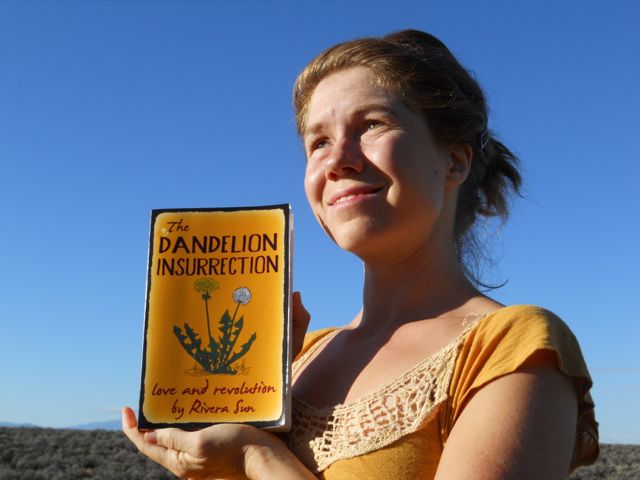
Rivera Sun is the author of two novels and many essays, plays, and poems. Most of her essays are archived on this website. Her writings have appeared in Truthout.org, Popular Resistance.org, Dandelion Salad.org, the Fayetteville Free Zone, Occupy.com, and many others. All of Rivera Sun’s published novels (including Steam Drills, Treadmills, and Shootings Stars and The Dandelion Insurrection), as well as her  plays, and poetry can be found here.

Workshops

Rivera Sun offers workshops in writing, social media skills, and making change through nonviolent actions. Please visit our upcoming workshops page to find an event near you or contact us.

Rivera Sun carrying the giant Dolores Huerta puppet in Love-In-Action's Activists, Whistleblowers, and Muckrakers procession. Puppet built by Jeanne Green and Marilyn Hoff. Photo by Dariel Garner

Changemaking Through Nonviolent Action

Rivera Sun is the cofounder of the Love-In-Action Network, a nationwide set of nonviolent study and action groups. She is also a graduate of the James Lawson Institute on Strategic Civil Resistance and has written many essays on the subject of nonviolent action. Learn more about how ordinary people can make extraordinary changes in our world! Here. 

Social Media Trainings and Service

Using collaborative social media approach, Rivera Sun and her partner, Dariel Garner, work to grow organizations’ social media outreach, allowing these groups to unite, connect, and inspire their participants and allies. In 2014, they expanded the social media outreach of the Metta Center for Nonviolence, and currently they serve Pace e Bene’s rapidly growing Campaign Nonviolence project, working with their organizers, staff, endorsing groups, and participants to develop social media skills, support and uplift the movement, and build sincere relationships through the medium of social media. For more information about our approach, or to bring these techniques to your organization, please contact us!

Occupy Radio

Rivera Sun at a reading. Moby Dickens Bookshop, Taos, NM

Rivera Sun cohost the weekly program, Occupy Radio. Founded by her cohost, David Geitgey Sierralupe (Getch), Rivera has been interviewing guests like Medea Benjamin, Jill Stein, Radley Balko, George Lakey, Michael Nagler, Thomas Linzey, Wenonah Hauter and many more since 2013. Listen to podcasts here.

To download, right-click and select “Save link as…” PUNKONOMICS 2-4-15 PT.1

Members of the Orlando Light Brigade and Speak Up Florida joined Rivera Sun  to talk about her Florida Tour, Orlando in particular, and other issues facing the Movement of Movements.

Hosted by Dr. Beni Balak and special co-host Shaheen Alhumaydhi (Jesse Velez is studying for grad school standardized test so send some good thoughts in his direction.

ABOUT RIVERA SUN (from http://www.riverasun.com/)

Order Rivera Sun's novels, plays, and poetry here!

My Story . . . a note from Rivera Sun
“Thirty-two years is a short time on a rapidly spinning planet. My story begins at conception, along with my red-headed twin sister, and rapidly erupts into a wildly creative family that boasts five children born within three years of one another. (Two sets of twins.) We were all raised on an organic farm on the northern border of Maine …  read more.

Novels and Writings

Rivera Sun is the author of two novels and many essays, plays, and poems. Most of her essays are archived on this website. Her writings have appeared in Truthout.org, Popular Resistance.org, Dandelion Salad.org, the Fayetteville Free Zone, Occupy.com, and many others. All of Rivera Sun’s published novels (including Steam Drills, Treadmills, and Shootings Stars and The Dandelion Insurrection), as well as her  plays, and poetry can be found here.

Workshops

Rivera Sun offers workshops in writing, social media skills, and making change through nonviolent actions. Please visit our upcoming workshops page to find an event near you or contact us.

Rivera Sun carrying the giant Dolores Huerta puppet in Love-In-Action's Activists, Whistleblowers, and Muckrakers procession. Puppet built by Jeanne Green and Marilyn Hoff. Photo by Dariel Garner

Changemaking Through Nonviolent Action

Rivera Sun is the cofounder of the Love-In-Action Network, a nationwide set of nonviolent study and action groups. She is also a graduate of the James Lawson Institute on Strategic Civil Resistance and has written many essays on the subject of nonviolent action. Learn more about how ordinary people can make extraordinary changes in our world! Here. 

Social Media Trainings and Service

Using collaborative social media approach, Rivera Sun and her partner, Dariel Garner, work to grow organizations’ social media outreach, allowing these groups to unite, connect, and inspire their participants and allies. In 2014, they expanded the social media outreach of the Metta Center for Nonviolence, and currently they serve Pace e Bene’s rapidly growing Campaign Nonviolence project, working with their organizers, staff, endorsing groups, and participants to develop social media skills, support and uplift the movement, and build sincere relationships through the medium of social media. For more information about our approach, or to bring these techniques to your organization, please contact us!

Occupy Radio

Rivera Sun at a reading. Moby Dickens Bookshop, Taos, NM

Rivera Sun cohost the weekly program, Occupy Radio. Founded by her cohost, David Geitgey Sierralupe (Getch), Rivera has been interviewing guests like Medea Benjamin, Jill Stein, Radley Balko, George Lakey, Michael Nagler, Thomas Linzey, Wenonah Hauter and many more since 2013. Listen to podcasts here.

To download, right-click and select “Save link as…” SPEAK UP FLORIDA PT.2

wpid-wp-1409449618404.jpeg

Orlando Light Brigade doing some splendid urban guerrilla work :)

With us in the studio were:

We were later joined by Charlotte Trinquet du Lys to talk about French racism and other issues related to the recent Paris attacks.