Posts Tagged ‘justice’

Excellent analysis from http://venezuelanalysis.com/ specifically addressing the media coverage:

What’s going on in Venezuela?

By LEE SALTER, PHD, February 21st 2014

UK academic Lee Salter, an expert on media coverage of Venezuela, gives his view on the reasons behind and aims of the current opposition protests.

What’s going on in Venezuela?

It’s difficult to briefly explain the situation in Venezuela right now. The difficulty lies in the fact that it is complicated, like most things. No matter how various political protagonists, human rights groups and news media would like to paint things as simple, black and white, they are not. To understand one has to dig down, deep.

A particularly galling video on YouTube explains that millions of students took to the street to protest about crime and the security situation. The comments by Venezuelans on said video are telling. In fact, what English-speakers hear about Venezuela is one of the biggest problems – if a Venezuelan speaks English, chances are that they are part of the small minority of the (relatively) ultra-rich who’ve been fighting to overthrow democracy since 1998. The curious thing about them is that they know what to say to whom and when.

They know to say “communism”, “Cuba”, “democracy” and “human rights”. They know when to say these words and they know who to say them to. Crucially their cultural networks of communicative power allow them to do so. On one level it is as simple as this – the Venezuelan news media has traditionally been controlled by the ultra-rich minority (of around 5-10% of the population). Traditionally there has been no real alternative to this media dominance, beside the odd under-funded community radio station. Moreover, in order to become a journalist one needs the sort of training and contacts afforded only to the ultra-rich, alongside the cultural associations and linguistic ability.

As the U.S. political scientists Ronald Sylvia and Constantine Danopoulos explain, the availability of such cultural capital is restricted: ‘Weekend shopping trips to Miami were the order of the day for the bourgeois classes. The oil riches, however, did not trickle down to the bottom of Venezuelan society. A sizeable portion of Venezuela’s population remained desperately poor’.

The ultra-rich have historically been well connected to Miami, the US more generally as well as to the international jet-set. They have media interests and media contacts and they dominate international communications about Venezuela. So, when a story needs to get out about the dramatic abuse of journalists (in one occasion I noted a human rights group release a story about such an abuse, which I investigated to find the original footage of a camera operator being jostled on a picket line), the lines of communication are open, and a primed international media is ready to accept anything that conforms to expectations.

The international diaspora of Venezuelans is largely on message. To be in another country, chances are they are part of the ultra-rich, or at least the middle class. Given the on-going relative poverty experienced by the majority of Venezuelans (which means they can’t afford the expensive plane tickets out), you’re not likely to ever hear the “other side”. It is thus that I heard from an “exile”, a really cool, funky hippie-type whose plight had caught the sympathy of everyone in her wide network of English friends: (paraphrased) “Chavez hates the people, he hates anyone with money. He is trying to stop the dams from producing electricity so that rich people can’t have televisions and things. In Caracas they only have 4 hours of electricity per day”. My response: I’ve just come back from ten days in Venezuela, and there was one power cut of about 20 minutes.

Another time I was stuck with rather scary English-speaking Venezuelan in a cable car in Caracas. She and her partner began talking to me and my friend about lightbulbs: “you know anything about Venezuela, about Chavez? He’s a communist you know? He’s trying to destroy the country. He’s trying to force everybody to have energy saving lightbulbs…but this isn’t Cuba”. After 5 minutes of ranting, my friend in his inimitable Irish accent gently explained that they have energy saving lightbulbs in Ireland and he doesn’t feel particularly oppressed by them.

I was baffled by the aggression and fury about electricity and lightbulbs. To a reasonable mind the explanation is as follows: Venezuela was experiencing a long, extended drought. Because of this, water levels in the hydro-electric dams were low so power generation was low. At the same time there were not enough engineers with the right expertise working on the dams and rivers for proper maintenance. The big problem, however, was the increase in the sales of consumer electrical items, such as refrigerators, encouraged by the government to improve the quality of life. So, drought + lack of care for hydroelectric plants + increase demand on electricity = power cuts. The short-term solution: energy saving items.

When quizzing Thomas Muhr, a researcher on Venezuela at the University of Bristol, about the mania over lightbulbs, he told me that it was all led by a rumour that Chavez was placing video cameras in in them so he could spy on them in their homes. Quite.

<EDIT: I’ll add this as it came through as a comment: “ there is not even food and if, you got killed trying to buy it milk on the corner of you house”. So here we have it – the Venezuelan government kills people for buying milk too>

The stories go on and on and on. One of the most striking things, however, is that when one gets to corruption and crime there is general agreement among most Venezuelans. Almost everyone I’ve ever spoken to in and around the Venezuelan government says the same – there’s too much corruption, we don’t seem to be able to do anything about crime, the revolution isn’t fast enough, the people don’t seem to realise what they can do and so on. That is to say, there’s no apparent wall of agreement around the government or the Bolivarian movement more generally that blinds them or others to shortcomings.

The other big problem is the one that is certainly not shared by the ultra-rich: how to stop the CIA and reactionary forces inside Venezuela from overthrowing the democratically elected government. This is the story through which the situation in Venezuela must be understood.

Most of the coverage of Venezuela in the Western corporate media plays on what is called the “exceptionalism thesis”. This is the idea that Venezuela is historically different to the rest of Latin America, insofar as it was stable and democratic. The thesis has been challenged by Steve Ellner and Miguel Salas, who, alongside an array of Latin American scholars point to the fact that prior to Chavez ‘Venezuela marked by extreme poverty set against a narrowly constituted elite of 5-10% of the population’ according to Princeton University’s Kelly Hoffman and Miguel Centeno. According to Julia Buxton of Bradford University, between 1975 and 1995 poverty increased dramatically, with the percentage of persons living in poverty rising from 33% to 70% during that period, the number of households in poverty increased from 15% to 45% between 1975 and 1995, by 2000 wages had dropped 40% from their 1980 levels, and by 1997 67% of Venezuelans earned less than $2 a day. There’s very little in the data that distinguishes Venezuela. Add to that the historically airbrushed atrocity of the Caracazo Massacre, where thousands of poor people were slaughtered in the same year as Tiananmen Square, for protesting IMF dictats, and there’s very little if anything for the poor to hark back to.

Such an understanding is lost on the international media who are more than encouraged to reflect back on an imagined era prior to Chavez, when the country was “unified” (one presumes happy in poverty and oppression) and “stable”. For example, my own research has outlined the narrative that the BBC inadvertently plays on (I say “inadvertently” because one of the correspondents whose work makes up the bulk of the sample we analysed is a committed Chavista), which masks the history of the majority.

The BBC’s narrative begins way back in 1998, before Chavez had been able to do anything. In December 1998 it told us that “Venezuela is proud of its democratic record”, that “many” see Chavez as a kind of autocratic military leader (remember he’d hardly done anything by then), and that in the good old days a high proportion of government spending went on social programmes. Amazing, really, that so many were still in poverty or voted for this demon from hell.

It took less than a year for the Beeb to mind us that “There is a dictatorship” in Venezuela. And for those idiots who think the fact that he was elected gives him legitimacy, remember that “Adolph Hitler was elected too”.

This framing of Chavez and the Bolivarian Revolution went on for the next ten years – Chavez came from nowhere, he’s a grave danger for Venezuela and the world, and … oh wow, how did he get elected again?!

By 2002 the emboldened “opposition”, a term which cannot but bestow legitimacy, had used the vast private media to launch a bloody coup. That they did this with their allies in the private media is incontestable given the arrogance of right-wing reactionaries in Venezuela – they told us so on air.

Yet for the BBC Chavez had “quit” due to his “mishandling” of “strikes” (actually a management lockout) and a demonstration in which Chavez decide to murder his own supporters. Fortunately “Venezuela … looked not to an existing politician but to the head of the business leaders’ association”, Pedro Carmona. In the world of the BBC (which, to be fair to the BBC was dependent on the international news agencies, which in turn depended on local journalists, who in the main work for the private media that helped launch the coup… and so on), the coup was actually “Venezuela” forming a transitional government and “restoring democracy”. On this account, democracy appears to be something that involves the ultra-rich shooting people and seizing power.

The situation never changed. No matter how many democratic elections Chavez, the movement he led or the party he helped form won, no matter what level of electoral legitimacy Venezuelans (rather than the BBC’s “Venezuela”) bestowed on Chavez, the government could not stand, and the implacable reactionaries would not cease until the Old Order was restored (unless they are talking to the rest of the world, in which case the line tends to be, “oh I’m sure they’re well-meaning and the social programmes are good, but there are too many bad people around and too much mismanagement”).

The most recent protests are indeed about a lot of things, and no doubt reflect a plethora of voices, just as there’s a variety of voices within the movement. Indeed, Venezuela still has problems, a lot of problems. Yet the “opposition” is as concerned with poverty as its leaders were when they presided over massive levels of poverty. They are as concerned with human rights as they were during the Caracazo Massacre. They are as concerned with democracy as they were when there was de facto exclusion of most of the population from political life. The big fear is the change in this latter. And it is this fear of the “plebs” that drives the “opposition”.

There’s a familiar story about states that sit outside the sphere of US hegemony – they tend to face campaigns of destabilisation, coups and invasions where necessary. The invariable response to such threats is to “clamp down” on previously enjoyed freedoms. The notion of a “strategy of tension” demands that a government is put in a defensive position, a “state of emergency” as it’s called in a friendly state. It is also this reaction, the context of which is rarely mediated, that motivates a number of the protesters.

It is worth reflecting how other states of emergency are mediated. After the 2011 riots in the UK, 3000 young people were swept up in a dragnet and sent to kangaroo courts for what would no doubt be called in Venezuela, a protest against an out of touch and corrupt government. The repressive clampdown was cheered on by the British media. Yet if the current President Maduro or Chavez before him had received as small a proportion of the vote as Cameron, Venezuela would probably have been invaded by now.

Contrast the conduct of broadcast media in the UK with that of Venezuela. It’s not simply that the private media in Venezuela have been “biased” in their coverage of politics, which British broadcasters are forbidden by law to be, it’s that they actively initiated an coup against democracy in 2002 that lead to the deaths of hundreds. Should Trevor Phillips appear on ITV News and council the army and navy to rise up against the government he’d be gone in the blink of an eye. Should his bosses support his position and continue to encourage such action on a daily basis for years it’s hardly outlandish to suggest that the ITV licence would not be renewed, as happened in Venezuela

In a sense the Venezuelan government is playing into the hands of the reactionaries and their supporters in the US. Some of the measures taken to ward off coup threats and enable a government that’s never garnered less than 50% of the vote to carry out its mandate have been clunky to put it mildly. Yet at the same time, it is difficult to see how else, other than emergency measures, the will of the people could be fulfilled.

Indeed, it is this that is the crux of the situation in Venezuela. It is not about a sudden emergence of economic problems, corruption or crime. It is about the ultra-rich and their supporters, especially among the middle class who for 15 years have spent their time, energy and resources trying every measure possible to overthrow the will of the people. Again, there are problems a plenty in Venezuela but the trick is to understand these in the context of the bigger picture.

Source: Lee Salter

from the Center for Popular Economics

http://www.populareconomics.org/2014/02/whose-recovery/

Whose Recovery?

Posted by  on February 18th, 2014

by Jerry Friedman

Whose Recovery

There is a story that when the late union leader Walter Reuther was given a tour of a GM plant, a manager introduced him to a set of the company’s new robots.  The manager challenged Reuther to say how he would organize the robots into the UAW.  The union leader supposedly responded by asking: how will General Motors sell cars to the robots?  While American unions have failed to organize the workers in the new economy’s factories, its capitalists seem to have figured out a good answer to Reuther’s question.

We shouldn’t be surprised that conservative politicians and orthodox economists are calling for the Federal Reserve to end its program of monetary ease and for the Federal government to end its program of extended unemployment insurance.  Believing in Say’s Law and the virtues of unregulated markets, they have never been comfortable with state action to help the unemployed; instead, they have long argued that the only proper role for government is to protect price stability and the integrity of banking system.

What should surprise us is that so few in the business community are pushing back against these ideologues in support of policies to bolster economic growth and employment.  Robert Reich asks whether capitalists and managers have forgotten the basic Fordist compromise, in which businesses rely on affluent workers to consume their products?[1]  If a rising tide lifts all boats, don’t capitalists benefit when unemployment falls and workers have more to spend?  And shouldn’t they support policies that bring the tide in?

They don’t because American capitalists have learned to profit from recession.  They have so well insulated their economic fortunes from the rest of us, that they no longer depend on rising wages and growing effective demand to maintain profitability.  The “recovery” from the Great Recession of 2008 has been different from past recoveries, because it has been led by profits, which have grown even though economic growth has been relatively slow, and employment and wages have stagnated.  Four years into the “recovery,” the GDP has grown at an anemic 2.4% per annum, the slowest growth rate of any post-war recovery and less than half that of the recovery in the 1960s.  Since the recession bottomed out in 2009, job creation has been only a third the rate of past recoveries.  Compared with past recoveries, this one is short 8 million jobs and the employment ratio, the share of the adult population with jobs, has fallen back to the level of the early 1970s, down 5 percentage points from 2008.

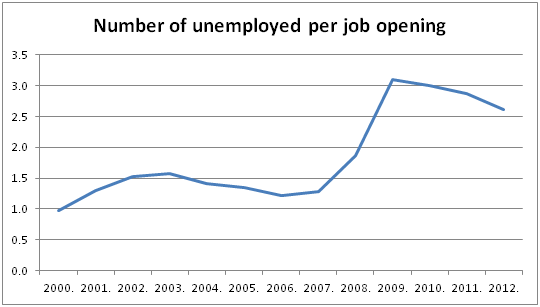
Those who call for the Federal Reserve to reverse course and urge Congress to cut programs to help the jobless cite the declining unemployment rate, which is down a third from its peak in 2009.  While declining unemployment is a good thing, much of the decline in the unemployment rate is because 10 million people have left the labor force.  The number of discouraged workers remains above its late 2009 level, while the number of unemployed workers per job opening has fallen only slightly from its 2009 peak (see Figure 1).  With the weight of unemployed and underemployed workers on the job market, wages have remained stagnant in this recovery despite rising productivity, continuing a decades-long trend.

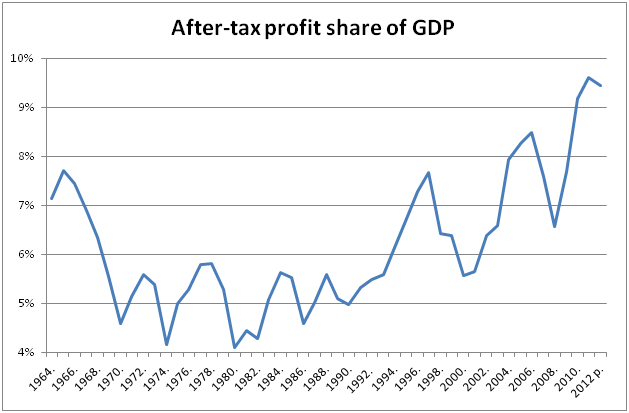
Despite slow economic growth, little job creation, and stagnant wages, some parts of the economy have boomed: the stock market and corporate profits.  After dramatic drops early in the recession, the Dow Jones Industrial Average has risen to new highs, growing in real terms significantly faster than in past recoveries.  While there may be some speculative element to the run-up in the Dow, it is well-supported by corporate profits, which have recovered fully from a sharp fall when the recession began to renew a 30 year climb (see Figure 2).

At least for now, American capitalists have solved the problem that bedeviled their Fordist forebears.  They have found ways to profit even when their workers cannot buy their stuff.  Since 2009, inflation-adjusted spending by the top 5% has risen 17 percent, compared with an anemic 1 percent among the rest.[2]  While Sears and J.C. Penney drift towards bankruptcy, Nordstrom and other luxury brands flourish.  Rather than depending on sales to working-class and middle-class consumers American corporations are doing very well selling to rich consumers, here and abroad.  Rather than promising workers high wages to ensure productivity, they maintain labor discipline through fear.

It seems that capitalists and managers have found answer to Reuther’s question. Business can’t sell stuff to robots, but they don’t need to sell stuff to workers either.


[1] “Why The Three Biggest Economic Lessons Were Forgotten,” accessed February 13, 2014, http://robertreich.org/post/76339971895.

[2] Nelson D. Schwartz, “The Middle Class Is Steadily Eroding. Just Ask the Business World.,” The New York Times, February 2, 2014, http://www.nytimes.com/2014/02/03/business/the-middle-class-is-steadily-eroding-just-ask-the-business-world.html; Barry Z. Cynamon and Steven M. Fazzari, Inequality, the Great Recession, and Slow Recovery, SSRN Scholarly Paper (Rochester, NY: Social Science Research Network, January 23, 2014), http://papers.ssrn.com/abstract=2205524.

http://opinionator.blogs.nytimes.com/2013/10/20/questions-for-free-market-moralists/

Questions for Free-Market Moralists

By AMIA SRINIVASAN
The Stone

The Stone is a forum for contemporary philosophers and other thinkers on issues both timely and timeless.

In 1971 John Rawls published “A Theory of Justice,” the most significant articulation and defense of political liberalism of the 20th century. Rawls proposed that the structure of a just society was the one that a group of rational actors would come up with if they were operating behind a “veil of ignorance” — that is, provided they had no prior knowledge what their gender, age, wealth, talents, ethnicity and education would be in the imagined society. Since no one would know in advance where in society they would end up, rational agents would select a society in which everyone was guaranteed basic rights, including equality of opportunity. Since genuine (rather than “on paper”) equality of opportunity requires substantial access to resources — shelter, medical care, education — Rawls’s rational actors would also make their society a redistributive one, ensuring a decent standard of life for everyone.

In 1974, Robert Nozick countered with “Anarchy, State, and Utopia.” He argued that a just society was simply one that resulted from an unfettered free market — and that the only legitimate function of the state was to ensure the workings of the free market by enforcing contracts and protecting citizens against violence, theft and fraud. (The seemingly redistributive policy of making people pay for such a “night watchman” state, Nozick argued, was in fact non-redistributive, since such a state would arise naturally through free bargaining.) If one person — Nozick uses the example of Wilt Chamberlain, the great basketball player — is able to produce a good or service that is in high demand, and others freely pay him for that good or service, then he deserves to get rich. And, once rich, he doesn’t owe anyone anything, since his wealth was accumulated through voluntary exchange in return for the goods and services he produced. Any attempt to “redistribute” his wealth, so long as it is earned through free market exchange, is, Nozick says, “forced labor.”

Rawls and Nozick represent the two poles of mainstream Western political discourse: welfare liberalism and laissez-faire liberalism, respectively. (It’s hardly a wide ideological spectrum, but that’s the mainstream for you.) On the whole, Western societies are still more Rawlsian than Nozickian: they tend to have social welfare systems and redistribute wealth through taxation. But since the 1970s, they have become steadily more Nozickian. Such creeping changes as the erosion of the welfare state, the privatization of the public sphere and increased protections for corporations go along with a moral worldview according to which the free market is the embodiment of justice. This rise in Nozickian thinking coincides with a dramatic increase in economic inequality in the United States over the past five decades — the top 1 percent of Americans saw their income multiply by 275 percent in the period from 1979 and 2007, while the middle 60 percent of Americans saw only a 40 percent increase. If the operations of the free market are always moral — the concrete realization of the principle that you get no more and no less than what you deserve — then there’s nothing in principle wrong with tremendous inequality.

The current economic crisis is no exception to the trend toward Nozickian market moralizing. In the recent debates in the Senate and House of Representatives about food stamps — received by one out of six Americans, about two-thirds of them children, disabled or elderly — Republicans made their case for slashing food subsidies largely about fairness. As Senator Jeff Sessions, Republican of Alabama, said in his speech, “This is more than just a financial issue. It is a moral issue as well.”

The Harvard economist N. Gregory Mankiw recently published a draft of a paper titled “Defending the One Percent.” In it he rehearses (but, oddly, does not cite) Nozick’s argument for the right of the wealthy to keep their money, referring to the moral principle of “just deserts” as what makes distribution by the market essentially ethical. And in a recent issue of Forbes, the Ayn Rand apostle Harry Binswanger proposed that those earning over one million dollars should be exempt from paying taxes, and the highest earner each year should be awarded a Medal of Honor — as a reward (and incentive) for producing so much market value. Again, Binswanger explained that “the real issue is not financial, but moral.”

The Nozickian outlook is often represented as moral common sense. But is it? Here I pose four questions for anyone inclined to accept Nozick’s argument that a just society is simply one in which the free market operates unfettered. Each question targets one of the premises or implications of Nozick’s argument. If you’re going to buy Nozick’s argument, you must say yes to all four. But doing so isn’t as easy as it might first appear.

1. Is any exchange between two people in the absence of direct physical compulsion by one party against the other (or the threat thereof) necessarily free?

If you say yes, then you think that people can never be coerced into action by circumstances that do not involve the direct physical compulsion of another person. Suppose a woman and her children are starving, and the only way she can feed her family, apart from theft, is to prostitute herself or to sell her organs. Since she undertakes these acts of exchange not because of direct physical coercion by another, but only because she is compelled by hunger and a lack of alternatives, they are free.

2. Is any free (not physically compelled) exchange morally permissible?

If you say yes, then you think that any free exchange can’t be exploitative and thus immoral. Suppose that I inherited from my rich parents a large plot of vacant land, and that you are my poor, landless neighbor. I offer you the following deal. You can work the land, doing all the hard labor of tilling, sowing, irrigating and harvesting. I’ll pay you $1 a day for a year. After that, I’ll sell the crop for $50,000. You decide this is your best available option, and so take the deal. Since you consent to this exchange, there’s nothing morally problematic about it.

3. Do people deserve all they are able, and only what they are able, to get through free exchange?

If you say yes, you think that what people deserve is largely a matter of luck. Why? First, because only a tiny minority of the population is lucky enough to inherit wealth from their parents. (A fact lost on Mitt Romney, who famously advised America’s youth to “take a shot, go for it, take a risk … borrow money if you have to from your parents, start a business.”) Since giving money to your kids is just another example of free exchange, there’s nothing wrong with the accumulation of wealth and privilege in the hands of the few. Second, people’s capacities to produce goods and services in demand on the market is largely a function of the lottery of their birth: their genetic predispositions, their parents’ education, the amount of race- and sex-based discrimination to which they’re subjected, their access to health care and good education.

It’s also a function of what the market happens to value at a particular time. Van Gogh, William Blake, Edgar Allan Poe, Vermeer, Melville and Schubert all died broke. If you’re a good Nozickian, you think that’s what they deserved.

4. Are people under no obligation to do anything they don’t freely want to do or freely commit themselves to doing?

If you say yes, then you think the only moral requirements are the ones we freely bring on ourselves — say, by making promises or contracts. Suppose I’m walking to the library and see a man drowning in the river. I decide that the pleasure I would get from saving his life wouldn’t exceed the cost of getting wet and the delay. So I walk on by. Since I made no contract with the man, I am under no obligation to save him.


Most of us, I suspect, will find it difficult to say yes to all four of these questions. (Even Nozick, in “Anarchy, State, and Utopia”, found it hard to say yes to Question 3.) In philosophical terms, we have a reductio ad absurdum. The Nozickian view implies what, from the perspective of common sense morality, is absurd: that a desperate person who sells her organs or body does so freely, that it’s fine to pay someone a paltry sum while profiting hugely off their labor, that people deserve to get rich because of accidents of birth, that there’s nothing wrong with walking by a drowning man. Thus Nozick’s view must be wrong: justice is not simply the unfettered exercise of the free market. Free market “morality” isn’t anything of the sort.

Some might object that these are extreme cases, and that all they show is that the market, to be fully moral, needs some tweaking. But to concede that there is more to freedom than consent, that there is such a thing as nonviolent exploitation, that people shouldn’t be rewarded and punished for accidents of birth, that we have moral obligations that extend beyond those we contractually incur — this is to concede that the entire Nozickian edifice is structurally unsound. The proponent of free market morality has lost his foundations.

Why worry about the morally pernicious implications of Nozickianism? After all, I said that most Western societies remain Rawlsian in their organization, even if they are growing more Nozickian in their ideology. In the United States for example, there are legal prohibitions on what people can sell, a safety net to help those who suffer from really bad luck, and a civic ethos that prevents us from letting people drown. The first answer is, of course, that the material reality is being rapidly shaped by the ideology, as recent debates about welfare in the United States demonstrate.

The second is that most Western societies hardly constitute a Rawlsian Utopia. People might be legally prohibited from selling their organs, but that doesn’t remedy the desperate circumstances that might compel them to do so. The law does not stop people from falling into poverty traps of borrowing and debt, from being exploited by debt settlement companies promising to help them escape those traps, or losing their homes after buying mortgages they can’t afford to pay back. And there is certainly no prohibition against the mind-numbing and often humiliating menial work that poor people do in exchange for paltry wages from hugely rich companies. A swiftly eroding welfare state might offer the thinnest of safety nets to those who fall on hard times, but it does nothing to address the lack of social mobility caused by the dramatic rise in inequality. And while it might be thought poor form to walk by a drowning man, letting children go hungry is considered not only permissible, but as Senator Sessions said, “a moral issue.” These facts might be not quite as ethically outraging as walking past a drowning man, but they, too, grate against our commonsense notions of fairness.

Rejecting the Nozickian worldview requires us to reflect on what justice really demands, rather than accepting the conventional wisdom that the market can take care of morality for us. If you remain a steadfast Nozickian, you have the option of biting the bullet (as philosophers like to say) and embracing the counterintuitive implications of your view. This would be at least more consistent than what we have today: an ideology that parades as moral common sense.


Amia Srinivasan is a fellow in philosophy at All Souls College, University of Oxford. She is an occasional contributor to The London Review of Books.

Inequality By Design: It’s Not Just Talent and Hard Work

Print
Saturday, 15 February 2014 14:54
Greg Mankiw is out there defending the 1 percent again. He put forward the argument that the big bucks are simply their just desserts; the rewards for exceptional skill and hard work.

His opening act is Robert Downey Jr. who apparently got $50 million for his starring role in a single movie. This is a great place to start. There’s no doubt that Robert Downey is an extremely talented actor, but of course there have been many actors over the years who have put in great performances for much less money. How is that Downey could earn so much more than a great actor from the 50s, 60s, or 70s?

We could give a simple answer and say something like globalization and technology, but that would be at best half right. Certainly many more people will be able to see the films that Downey acts in than would have had the opportunity to see the stars from a half century ago, but that doesn’t mean that Downey would get money from the broader exposure. In fact, a big part of the reason that Downey can collect huge paychecks is the extension and strengthening of copyrights. The United States has lengthened the period of copyrights from 28 years, with an option for a 28 year renewal, to 75 years in the 1976, and then to 95 years in 1998.

It also has stepped up copyright enforcement, imposing stiff fines on people who use the Internet to make unauthorized copies of copyrighted material. This is important, since the technology itself would let everyone quickly see Robert Downey Jr.’s new movies at no cost. It is only because of government intervention in the form of copyright monopolies that he is able to collect $50 million.

It is also worth noting that this intervention also has an indirect effect. If there was a large amount of high quality and recent material that everyone could obtain for free on the web (and show in theaters if they like), then no one would be willing to pay big bucks to see Downey’s latest feature. So is Downey worth his $50 million, perhaps given the structure we have, but we could easily have a different structure which could quite possibly be a more efficient way to support and distribute creative work. (Here‘s my scheme.) FWIW, a similar story would apply to the writers and athletes in Mankiw’s 1 percent defense.

Then we get to the CEOs who Mankiw tells us get high pay because of what they contribute to their companies and the economy. If this is the case, how do we explain CEO’s of companies like Lehman, Bear Stearns, and AIG walking away with hundreds of millions of dollars even though they drove their firms into bankruptcy? When the CEO of Exxon-Mobil gets hundreds of millions because soaring worldwide oil prices sent Exxon’s profits through the roof, do we really think the pay is a function of hard work? How do we explain the fact that CEOs of incredibly successful companies in Europe, Japan, and South Korea make on average around a tenth as much as our crew does?

That one doesn’t seem to fit the just desserts story. The more likely explanation is the Pay Pals story, where the company’s board of directors are paid off by CEOs to look the other way as they pilfer the company.  (See CEPR’s new Director Watch, which will feature your favorite directors in the months and years ahead.) Unlike the case in Europe, Japan, and South Korea, there is no force to effectively limit the CEO’s pay. Needless to say, the directors never ask if they could get a comparably skilled CEO for less money from Germany, Japan, or China.

And then there is the financial sector where Mankiw tells us that the extraordinary pay is compensation for the volatility of paychecks. That’s interesting, except the vast majority of comparably talented and hardworking people would be happy to get the pay the finance folks get in the bad years. Much of the big money on Wall Street stems from highly leveraged bets that beat the market by seconds or even milliseconds. This provides as much value to the economy as insider trading, which it in fact it resembles closely.

It would be interesting to see what would happen to the big fortunes in the financial sector if it had to pay a small transaction fee, effectively subjecting it to the same sort of sales tax that is paid in almost every other sector of the economy. It would also be interesting to see what would happen to the private equity folks if they lost the opportunity for the tax gaming that is their bread and butter.

I could go on (read my non-copyright protected book on the topic), but the point should be clear. If the 1 percent are able to extract vast sums from the economy it is because we have structured the economy for this purpose. It could easily be structured differently, but the 1 percent and its defenders aren’t interested in changing things. And the 1 percent and its defenders have a great deal of influence on the direction of economic policy.

Image