▶ Mandela The Man and His Country – YouTube.
Let’s not forget how conservatives in the UK and the US called for his execution and/or continues imprisonment and supported the racist apartheid regime in South Africa. Just like they continue to do so today but now most so-called liberals are also conservatives so opposing such horrors has become a radical position. FTW
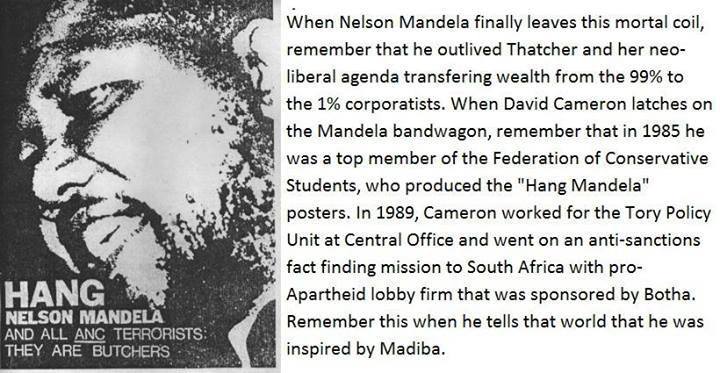
Here are 2 short articles about this:
UK http://www.the-bastard.com/index.php?section=42&page=3027
US http://www.salon.com/2000/08/01/south_africa_3/

Dalai Lama describes himself as “half-Marxist, half-Buddhist”

He was at it again the other day, telling Chinese students that he considers himself a Marxist. This wasn’t just playing to the crowd – although it was reported with surprise (at least in the US), the ideological alignment is longstanding. In 1993, he said: “The economic system of Marxism is founded on moral principles, while capitalism is concerned only with gain and profitability. Marxism is concerned with the distribution of wealth on an equal basis … as well as the fate of those who are underprivileged and in need, and [it] cares about the victims of minority-imposed exploitation. For those reasons, the system appeals to me, and it seems fair.”
There are a number of caveats (he’s not a Leninist, believes compassion rather than class struggle is key, and doesn’t consider communist regimes such as the USSR, China or Vietnam to have been true exponents), but the dissonance between image and reality remains – the Dalai Lama is not the comforting Oriental pet that consumer society might like.
Neither does his tradition match the capitalist fantasies attached to it. Perhaps because Buddhism came to the west on a wave of post-war hippy soul-searching, and was then co-opted as friendly religion of choice by new ageism and the self-help movement, its radical economic and social messages have been lost under an avalanche of laughing fat-man statues, healing crystals and copies of The Secret.
The very idea of self-help in Buddhism is an oxymoron – relief of suffering can only come from the realisation that pleasing ourselves doesn’t bring happiness – instead we must try to work skilfully and compassionately with others, as part of interwoven systems of connectivity that bind us together. A “western Buddhism” that prioritises solipsistic focus on the individual is so great a misconception as to be unworthy of the name – or at the least the Buddhism part – as anyone who pays it more than passing attention knows. It’s also largely a media invention – many western Buddhists are serious, deeply committed practitioners. That commitment means choosing to follow a path that leads against the stream of materialism and selfishness. Of course, we don’t always manage it, but that’s why it’s called a path of practice.
Buddhism goes way beyond the confines of the personal – realising the truth of interdependence implies taking up the challenge of engaging with others in the wider world. This isn’t missionary zeal – proselytising is hardly the Buddhist way – but it does mean social action that embodies dharmic principles, and western sanghas are increasingly prioritising community involvement. As they do so, Buddhism may start to look less like some nice bit of calm and relaxation and more like a radical, uncompromising critique of the status quo.
This critique has already begun to influence the UK mainstream. It’s 45 years since EF Schumacher published his Buddhist Economics essay in Small is Beautiful, which the Times Literary Supplement listed as one of the 100 most influential books since the second world war. Though the male-centric, mechanistic world it describes now seems dated, Schumacher’s outline of a world driven mad by consumption (and his Buddhist-inspired remedy of sufficiency and sustainability) has informed everything from the climate change debate to the happiness agenda – particularly through the influentialNew Economics Foundation (NEF) thinktank, which grew out of Schumacher’s vision.
The well-being indices enthusiastically taken up by David Cameron have grown in part from NEF’s links with the kingdom of Bhutan and its policy of favouring gross national happiness above gross domestic product. Is the prime minister aware of the Buddhist foundation to his plans for the nation’s mood?
Of course, we’re a long way from a government that looks even remotely dharmic. From a Buddhist perspective, only a revolution in our collective mind can counter the momentum that keeps us grasping for happiness in all the wrong places. And that would involve more than measuring whether someone with a job and a family in sunny Cornwall feels more upbeat than a lonely, unemployed Londoner on a rainy day. It would require systemic transformation on both an intimate and a huge scale, bringing the path of personal practice together with much broader societal shifts. Could this be what the Dalai Lama is thinking of when he describes himself as “half-Marxist, half-Buddhist”?


Pope Francis’ Five Most Radical Statements On Capitalism And Poverty.
By Eric Brown on November 26 2013
Capitalism comes under attack again in the latest publication from Pope Francis. On Tuesday the pontiff published his first long-form document written as pope, known as an apostolic exhortation. The 84-page “Evangelii Gaudium” (The Joy of the Gospel) speaks at length about the evils of unfettered capitalism and the church’s need to minister to the poor.
It’s not the first time the pope has attacked capitalism. Since his election to the papacy eight months ago, Pope Francis has made a name for himself as a radical by calling for reform of global financial systems that exclude the poor to the benefit of the rich.
Below, check out five of Pope Francis’ most revolutionary statements on capitalism and global income inequality, from “Evangelii Guadium” and other sources.
Capitalism Kills
In Pope Francis’ apostolic exhortation, he takes some of his harshest shots yet at global capitalism, saying that economies that prey on the poor are tantamount to murder.
“Just as the commandment ‘Thou shalt not kill’ sets a clear limit in order to safeguard the value of human life, today we also have to say “thou shalt not” to an economy of exclusion and inequality. Such an economy kills. How can it be that it is not a news item when an elderly homeless person dies of exposure, but it is news when the stock market loses two points? This is a case of exclusion.”
Trickle-Down Economics
With “Evangelii Gaudium,” Francis also blasted trickle-down economic theories, saying that those in economic power will always work to benefit themselves and not the poor in such a scenario.
“Some people continue to defend trickle-down theories which assume that economic growth, encouraged by a free market, will inevitably succeed in bringing about greater justice and inclusiveness in the world. This opinion, which has never been confirmed by the facts, expresses a crude and naïve trust in the goodness of those wielding economic power and in the sacralized workings of the prevailing economic system. Meanwhile, the excluded are still waiting.”
The Catholic Church Is for the Poor
Pope Francis isn’t just content to attack financial problems outside of the church, either. In an interview with Italian journalist (and atheist) Eugenio Scalfari, Pope Francis questioned the Catholic Church itself, claiming that the church must be focused on the poor, not on itself or divisive issues like same-sex marriage and abortion.
“Heads of the Church have often been narcissists, flattered and thrilled by their courtiers. The court is the leprosy of the papacy. The Church is or should go back to being a community of God’s people, and priests, pastors and bishops who have the care of souls are at the service of the people of God.”
“I believe I have already said that our goal is not to proselytize but to listen to needs, desires and disappointments, despair, hope. We must restore hope to young people, help the old, be open to the future, spread love. Be poor among the poor. We need to include the excluded and preach peace.”
God Says to Focus on Poor
Speaking about his past and present as a Jesuit with American Magazine, Pope Francis claimed that his decisions to eschew material wealth and minister to the poor come directly from God.
“Discernment is always done in the presence of the Lord, looking at the signs, listening to the things that happen, the feeling of the people, especially the poor. My choices, including those related to the day-to-day aspects of life, like the use of a modest car, are related to a spiritual discernment that responds to a need that arises from looking at things, at people and from reading the signs of the times. Discernment in the Lord guides me in my way of governing.”
Capitalism Is Idolatry
In an open letter to British Prime Minister David Cameron on the eve of the G-8 Summit, Pope Francis called capitalism a new form of idolatry, saying the money should “serve” humanity, not lead it.
“The goal of economics and politics is to serve humanity, beginning with the poorest and most vulnerable wherever they may be, even in their mothers’ wombs. Every economic and political theory or action must set about providing each inhabitant of the planet with the minimum wherewithal to live in dignity and freedom, with the possibility of supporting a family, educating children, praising God and developing one’s own human potential.”
“We have created new idols. The worship of the golden calf of old has found a new and heartless image in the cult of money and the dictatorship of an economy which is faceless and lacking any truly humane goal.”


 Punkonomics (@DearBalak)